



Serving Midlands and Upstate, South Carolina

PHD in Customer Care

Professional • Honest • Dependable

1850+ Reviews
4.9 Rating

Serving Midlands and Upstate, South Carolina

Satisfaction Guaranteed • PHD in Customer Care

Bee Removal & Swarm Relocation

Bee identification and control for Midlands properties. Honey bees are pollinators
and belong in relocation rather than extermination, and we will tell you honestly which one you actually have.

BEE CONTROL THAT TARGETS THE SOURCE

A large share of bee calls turn out to be yellow jackets, which are wasps rather than bees and behave completely differently. Identification is the first and most important step, because it changes the right answer entirely.

Honey bees in a wall or structure should generally be relocated by a beekeeper. Carpenter bees are a structural problem that accumulates year after year. Bumble bees are pollinators that are usually best left alone.

READY TO STOP BEES?
70+

Years of Local Service

local & Family-Owned Since 1955

Why Choose
Modern Exterminating?

Modern Exterminating has been the longest-standing, local and family-owned pest control company serving the area since 1955. Now in its third generation, the company runs by a simple standard, a PHD in customer care: professional, honest, and dependable, on every visit.

  • Local and family owned since 1955
  • Satisfaction guaranteed on every service
  • Same-day appointments and services available
  • Highly trained, certified technicians
  • Deeply involved in the communities we serve

HOW BEE CONTROL WORKS

Identify the species, decide whether relocation or treatment is right, act accordingly, and seal the locations that attract nests.

1

Inspect & Identify

We identify the species and locate the nest or gallery, including ones inside wall voids that are not visible outside.

2

Build the Right Plan

Honey bees point toward relocation. Carpenter bees point toward treatment and wood repair. Yellow jackets are a different job entirely.

3

Treat with Purpose

Where treatment is appropriate, it is carried out with proper protective equipment by trained technicians.

4

Prevent & Follow Up

Sealing and finishing the wood carpenter bees target, plus guidance on the locations nests recur.

NEED PEST CONTROL?

BEES PROBLEMS?
WE CAN HELP.

Prefer to call?
Modern Exterminating Guarantee

Modern Exterminating stands behind every visit. If a problem returns within a reasonable time after treatment, we come back and address it at no extra charge.

WHAT TO KNOW ABOUT BEES

Quick answers on telling bees apart, what to do about a honey bee colony, and why carpenter bee damage adds up.

Honey bees

Pollinators, and generally not something to exterminate. A colony in a wall is usually a relocation job for a beekeeper rather than a pest control treatment.
Carpenter bees

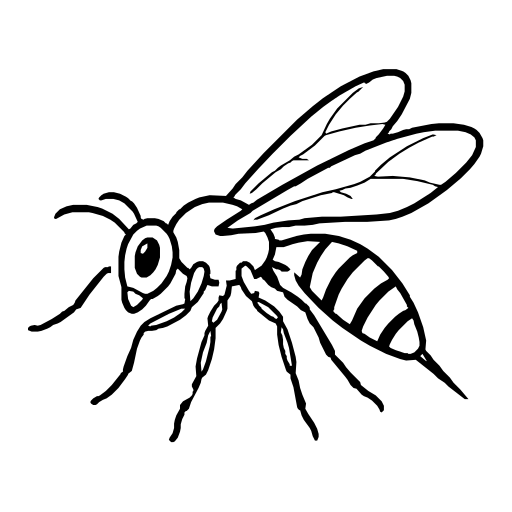
Large, with a shiny black abdomen. They bore round half-inch holes into eaves, fascia and railings and reuse the same galleries each year.
Bumble bees

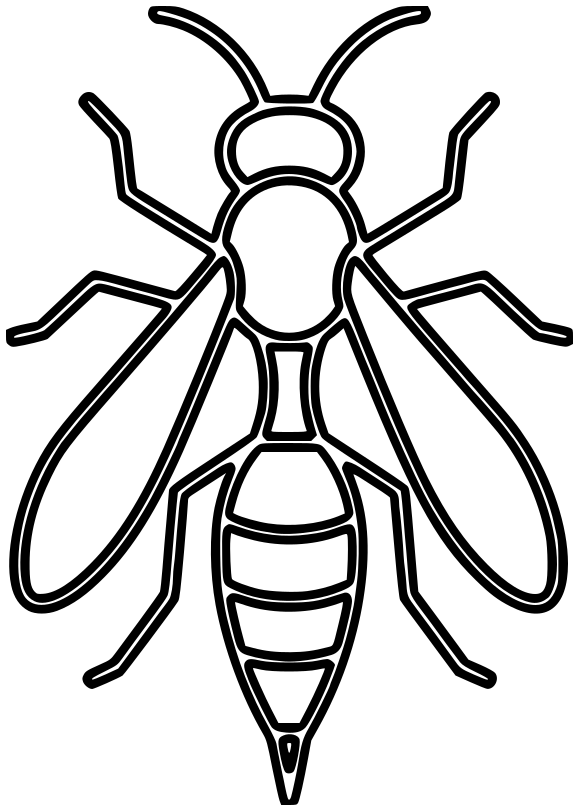
Fuzzy, round and important pollinators. They nest in the ground or in cavities and are generally best left alone unless the nest is in a high traffic area.

Is it actually a yellow jacket?

Often yes. Yellow jackets are wasps, far more aggressive, and they sting repeatedly. Many reported bee problems turn out to be them.
Bee Control for South Carolina Homes & Businesses

We do not treat honey bees as a routine pest. They are pollinators, populations are under pressure, and a colony in a structure is usually better resolved by relocation. Tell us what you are seeing and we will help you identify it correctly before anything is decided.

Carpenter bees are the exception. Males hover aggressively but have no stinger, and females rarely sting. The problem is the wood. They bore into eaves, fascia, decks and railings, extend the same galleries each season, and woodpeckers enlarge the holes hunting the larvae.

Help Keep Carpenter Bees Off Your Wood

Carpenter bees prefer bare, unfinished softwood, so surface treatment matters.

  • Paint or seal exposed wood on decks, railings, fascia and eaves.
  • Fill and seal old galleries in fall, after activity ends.
  • Inspect eaves and railings in early spring, when activity starts.
  • Replace badly damaged wood rather than repeatedly filling it.
  • Consider hardwood or composite for high exposure trim.

For honey bees, call us before doing anything. Sealing a colony into a wall creates a far worse problem than the bees themselves.

Frequently Asked Bee Control Questions

Do not seal the entrance. Trapped bees push into living space and the abandoned comb draws other pests. Call us and we will help identify it and point you toward relocation.

Yes, cumulatively. Individual galleries are small, but they are reused and extended each year, and woodpeckers enlarge them hunting larvae. Over several seasons the damage is real.

Appointment length depends on the treatment and property. Our team will explain what to expect, provide an arrival window, and call on the way.

Modern uses low-toxicity, professional products and follows service-specific safety requirements. Some treatments require people or pets to stay out of treated areas until the materials are dry or for a specified period.