
Serving Midlands and Upstate, South Carolina
PHD in Customer Care
Professional • Honest • Dependable

1850+ Reviews
4.9 Rating
Serving Midlands and Upstate, South Carolina
Satisfaction Guaranteed • PHD in Customer Care
Tick reduction in Lexington from our branch at 5223 Augusta Road. Barrier treatment along the wooded edge where ticks actually wait, not blanket lawn spraying.
Ticks do not spread across an open lawn. They wait in tall grass, leaf litter and the shaded transition zone where your yard meets woods, then climb onto whatever brushes past.
Lexington County has a lot of that transition zone. Subdivisions backing onto woods, greenway corridors and lake-adjacent lots all put the highest risk area right where families and pets spend time.

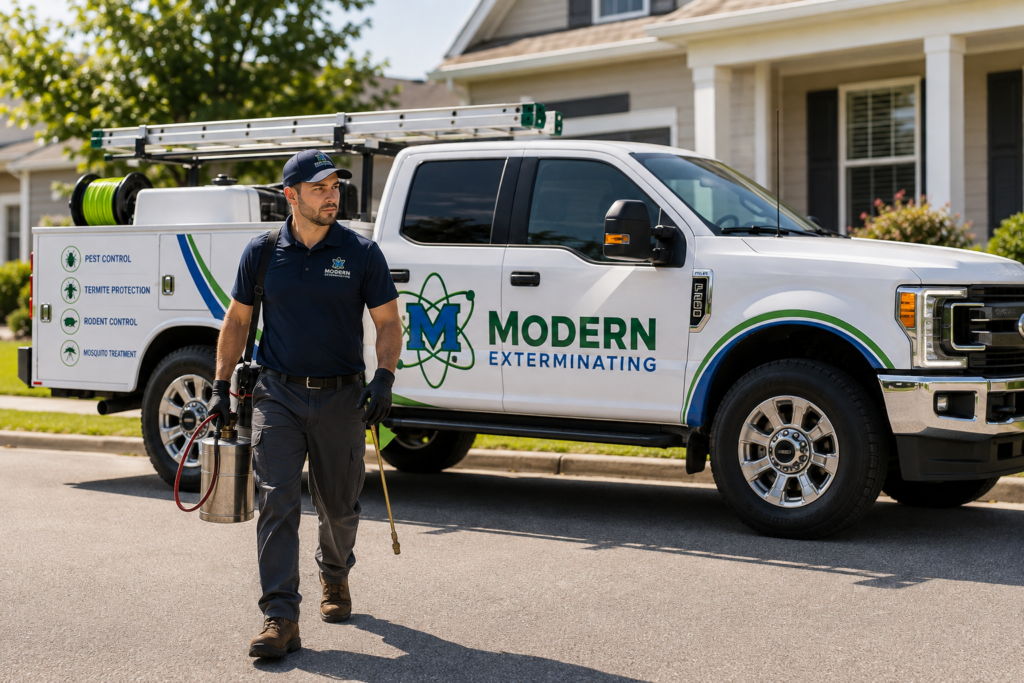
From recurring pest control and termite protection to wildlife, moisture, mosquito, and commercial programs, Modern builds practical solutions around your property. Integrated Pest Management guides our service-first approach.
Inspections, baiting systems, pre-construction treatment, and CL100 / WDO support.
Recurring and one-time protection for common household pests with an IPM-first approach.
Trapping, removal, exclusion, and damage repair for common South Carolina wildlife.
Every visit includes the same core steps, built to solve the problem instead of masking it for a few days.
A technician inspects the property inside and out, identifies the pest and the conditions behind it, and locates entry points and likely nest or harborage sites before any treatment begins.
2
The pest, the severity, and the property determine the plan. A minor problem calls for a different approach than a heavy infestation or a structural issue.
3
Technicians apply targeted treatments at entry points, nesting sites, and problem areas, matched to the pest and the property, indoors and outdoors as needed.
4
After treatment, technicians point out conditions that invite pests back, such as moisture or exposed food sources, and schedule follow-up service if activity continues.
Treatment concentrates on habitat edges and harborage rather than blanket application, because that is where ticks actually are.
Years of Local Service
local & Family-Owned Since 1955
Modern Exterminating has been the longest-standing, local and family-owned pest control company serving the area since 1955. Now in its third generation, the company runs by a simple standard, a PHD in customer care: professional, honest, and dependable, on every visit.
South Carolina ticks are active nearly year round. Activity peaks in spring and early summer, but mild Midlands winters mean they do not fully shut down, so pressure runs longer here than in most of the country.
Lone star ticks are the most commonly encountered and are associated with alpha-gal syndrome, the red meat allergy. American dog ticks carry Rocky Mountain spotted fever, and blacklegged ticks carry Lyme, which is present here though at lower rates than the Northeast.
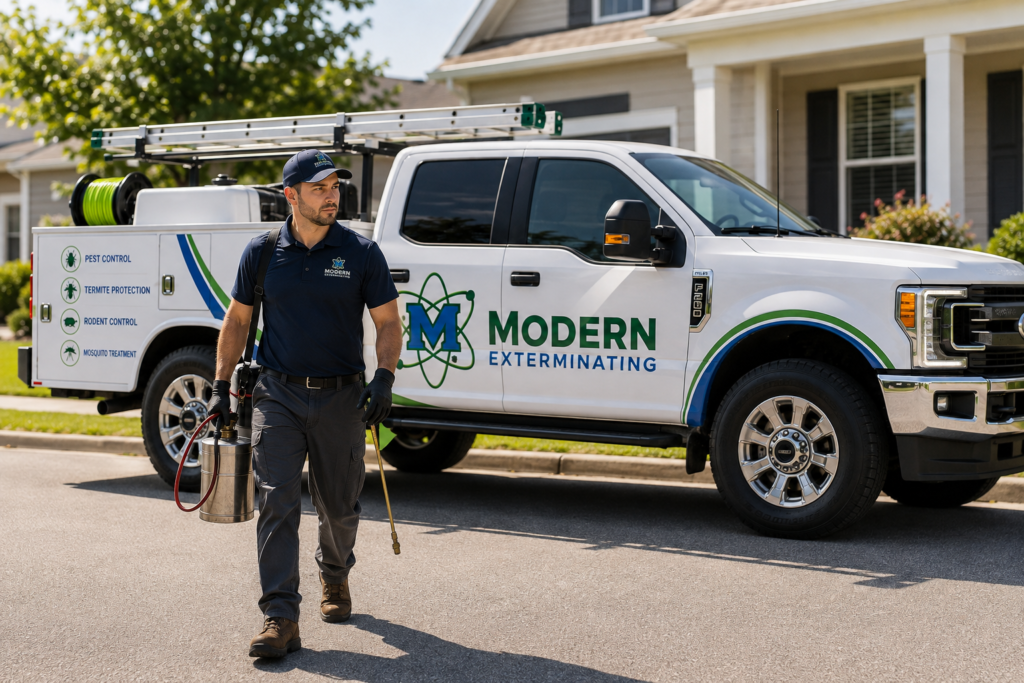
Habitat management does as much as treatment, and the two together do the most.
Keep grass mowed short, clear leaf litter along the wooded edge, create a gravel or mulch barrier between lawn and woods, and move play equipment and seating away from the tree line and into sun.
Ticks arrive on hosts: deer, mice, raccoons and opossums. Mice in particular are a major reservoir for the pathogens ticks transmit, so rodent reduction lowers tick pressure directly.
Nearly year round, peaking in spring and early summer. Mild Midlands winters mean they do not fully shut down, which makes this a longer season than most of the country sees.
It substantially reduces the population in the treated area. Ticks keep arriving on wildlife, so seasonal treatment paired with habitat management is the realistic approach.
Fine-tipped tweezers, grasp close to the skin, pull straight up with steady pressure. Do not twist, and skip petroleum jelly and matches. Contact a doctor if a rash or fever develops.
Yes, and it is common. They share the same shaded, humid habitat, so the treatment zones overlap almost entirely.