


Serving Midlands and Upstate, South Carolina
PHD in Customer Care
Professional • Honest • Dependable
1850+ Reviews
4.9 Rating
Serving Midlands and Upstate, South Carolina
Satisfaction Guaranteed • PHD in Customer Care
Professional ant control for South Carolina homes and businesses. We identify the species, locate the nest, and use bait the foragers carry back, because spraying the trail you can see leaves the colony producing replacements.
The ants you see on the counter are a fraction of the colony. Spraying them kills the foragers and leaves the nest producing replacements, which is why store-bought sprays feel like they work for two days and then stop.
Effective ant control works the other direction: identify the species, find the nest, and use bait the foragers carry back to it. Different ants need different bait, and what eliminates an odorous house ant colony does nothing to a fire ant mound.
Years of Local Service
local & Family-Owned Since 1955
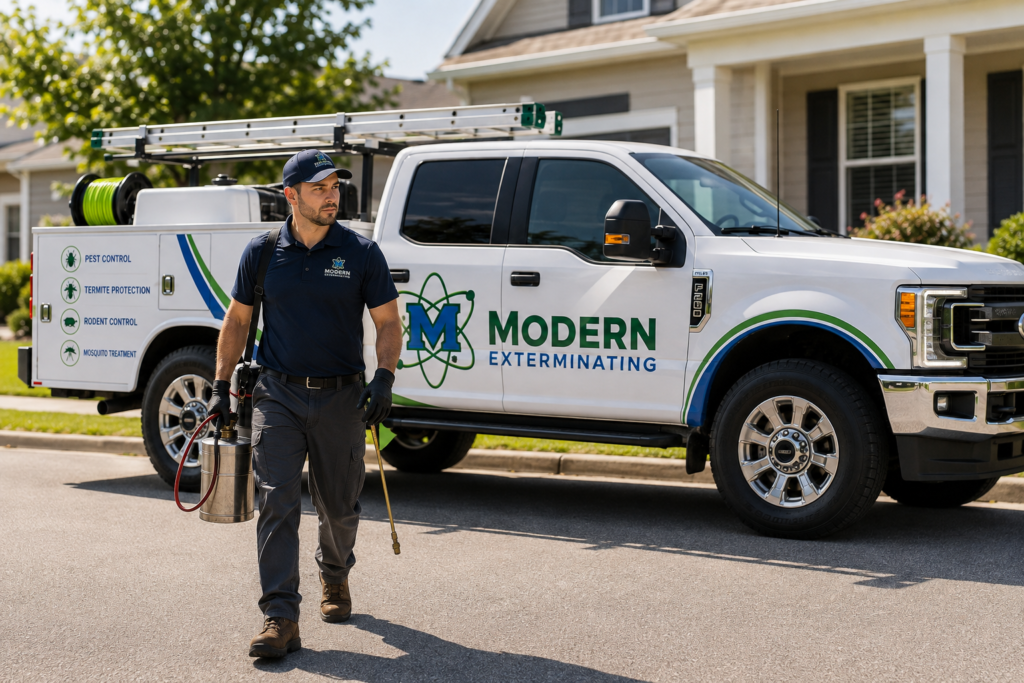
Modern Exterminating has been the longest-standing, local and family-owned pest control company serving the area since 1955. Now in its third generation, the company runs by a simple standard, a PHD in customer care: professional, honest, and dependable, on every visit.
Identify the species, find the nest, treat with bait the colony carries home, then reduce the conditions that let ants back in.
We identify the species and locate trails, nests, entry points, and the food or moisture drawing them in. Species drives everything.
2
Bait and placement matched to the species. What eliminates odorous house ants does nothing to a fire ant mound.
3
Bait the foragers carry back to the nest, which is what eliminates the colony rather than the ants you see.
4
Exterior treatment and entry-point guidance so the next colony does not simply take the same route in.
Modern stands behind its pest control work. If a problem comes back within a reasonable time after service, contact our team and we’ll help address it according to the service plan.
Quick answers on why ants come in, what draws them, and why spraying a trail can make some ant problems worse instead of better.
Food, water, shelter, and easy access around foundations, doors, windows and utility lines. A visible trail is usually one branch of a colony nesting somewhere you cannot see.
Food residue, open pantry items, pet food, standing water, damp wood from a leak, and vegetation touching the house that bridges your treated perimeter.
Seal food, clean spills including under appliances, fix leaks and condensation, trim vegetation back from the house, and move mulch and firewood away from the foundation.
If trails keep returning, activity is spreading, or you cannot find the source. With odorous house ants and Argentine ants, spraying can split the colony and make it worse.
South Carolina’s climate keeps ants active far longer than most of the country, and the Midlands has a species mix that includes some of the harder ones to control.
Fire ants build mounds in open lawn and are a genuine safety issue with children and pets. Odorous house ants have multiple queens and split when disturbed, which is exactly why spraying makes them worse. Carpenter ants nest in damp or damaged wood, so finding them indoors usually means there is a moisture problem somewhere.
Treatment is one part of the job. Reducing what ants use for food, water, shelter and access makes the property less inviting.
Our technicians point out the prevention opportunities specific to your property during service.
Spraying kills foragers, not the colony. The nest keeps producing replacements. With some species it also triggers the colony to split and spread. Baiting works because the ants carry it home.
Baiting is not instant, and that is the point. You may see activity for several days as foragers carry bait back. A noticeable drop usually follows within one to two weeks.
Appointment length depends on the treatment and property. Our team will explain what to expect, provide an arrival window, and call on the way.
Modern uses low-toxicity, professional products and follows service-specific safety requirements. Some treatments require people or pets to stay out of treated areas until the materials are dry or for a specified period.