


Serving Midlands and Upstate, South Carolina
PHD in Customer Care
Professional • Honest • Dependable
1850+ Reviews
4.9 Rating
Serving Midlands and Upstate, South Carolina
Satisfaction Guaranteed • PHD in Customer Care
Yard tick reduction for South Carolina properties bordering wooded areas.
Ticks wait in specific places rather than spreading across a lawn, and that is what makes them treatable.
They sit in tall grass, leaf litter and the shaded transition zone where your yard meets woods, then climb onto whatever brushes past. Reduce that habitat and treat the edges, and exposure drops substantially.
South Carolina has several tick species that carry disease, and both the Midlands and Upstate have meaningful pressure. This is one of the few pest problems where the stakes are genuinely medical.
Years of Local Service
local & Family-Owned Since 1955
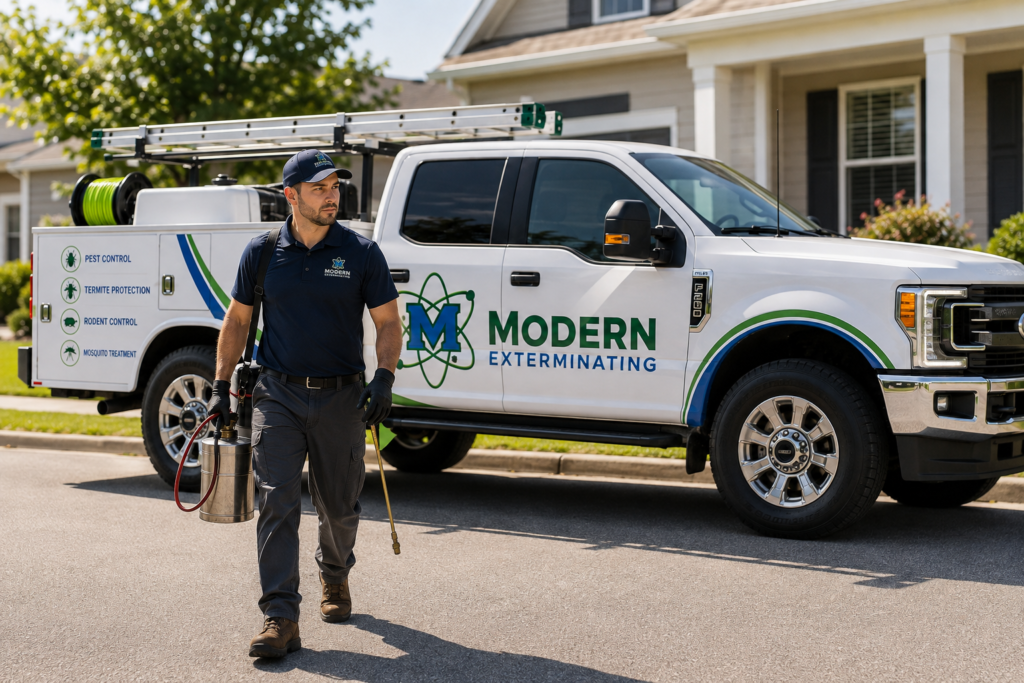
Modern Exterminating has been the longest-standing, local and family-owned pest control company serving the area since 1955. Now in its third generation, the company runs by a simple standard, a PHD in customer care: professional, honest, and dependable, on every visit.
Find the high risk zones, treat the habitat edges, reduce the wildlife bringing ticks in, and return through the season.
We identify the wooded edge, leaf litter and shaded transitions, and assess how your family and pets use the space.
2
Treatment is concentrated on habitat edges and harborage rather than applied across the whole lawn.
3
Targeted barrier treatment where ticks actually wait, timed to seasonal activity.
4
Landscape guidance and rodent reduction, because ticks arrive on hosts rather than appearing on their own.
Modern Exterminating stands behind every visit. If a problem returns within a reasonable time after treatment, we come back and address it at no extra charge.
Quick answers on which ticks are here, where they live on your property, and how to remove one correctly.
Lone star is the most common, identifiable by a white dot on the female's back. Also American dog tick, blacklegged deer tick and brown dog tick.
The wooded edge and transition zone by a wide margin, plus leaf litter, tall grass, and shaded humid spots where they avoid drying out.
Fine-tipped tweezers, grasp close to the skin, pull straight up with steady pressure. Do not twist, and skip petroleum jelly and matches.
Ticks arrive on hosts: deer, mice, raccoons and opossums. Mice in particular are a major reservoir for the pathogens ticks transmit.
Properties bordering woods, greenways or undeveloped land carry the most pressure, and there is a lot of that in the Midlands and Upstate.
Lone star ticks are associated with alpha-gal syndrome, the red meat allergy. American dog ticks are associated with Rocky Mountain spotted fever. Blacklegged ticks carry Lyme, which is present here though at lower rates than the Northeast. Brown dog ticks are unusual in that they can complete their whole life cycle indoors.
Habitat management does as much as treatment, and the two together do the most.
Mosquito and tick service pair naturally, because they share the same shaded, humid habitat.
Ticks are active nearly year round here. Activity peaks in spring and early summer, but mild Midlands winters mean they do not fully shut down. It is a longer season than in most of the country.
It substantially reduces the population in the treated area. Ticks keep arriving on wildlife, so seasonal treatment paired with habitat management is the realistic approach.
Appointment length depends on the treatment and property. Our team will explain what to expect, provide an arrival window, and call on the way.
Modern uses low-toxicity, professional products and follows service-specific safety requirements. Some treatments require people or pets to stay out of treated areas until the materials are dry or for a specified period.